‘Telangana next’: BJP signals big push after Bengal victory
BJP leaders in Telangana step up political messaging after Bengal and Assam results, banking on Modi’s visit and a massive Hyderabad rally to build momentum for upcoming elections.
Following the demolition, Telangana-based rights lawyer Rama Rao Immaneni moved a complaint before the National Monuments Authority. Acting on the complaint, the Union Ministry of Culture and the Archaeology Department have initiated proceedings.




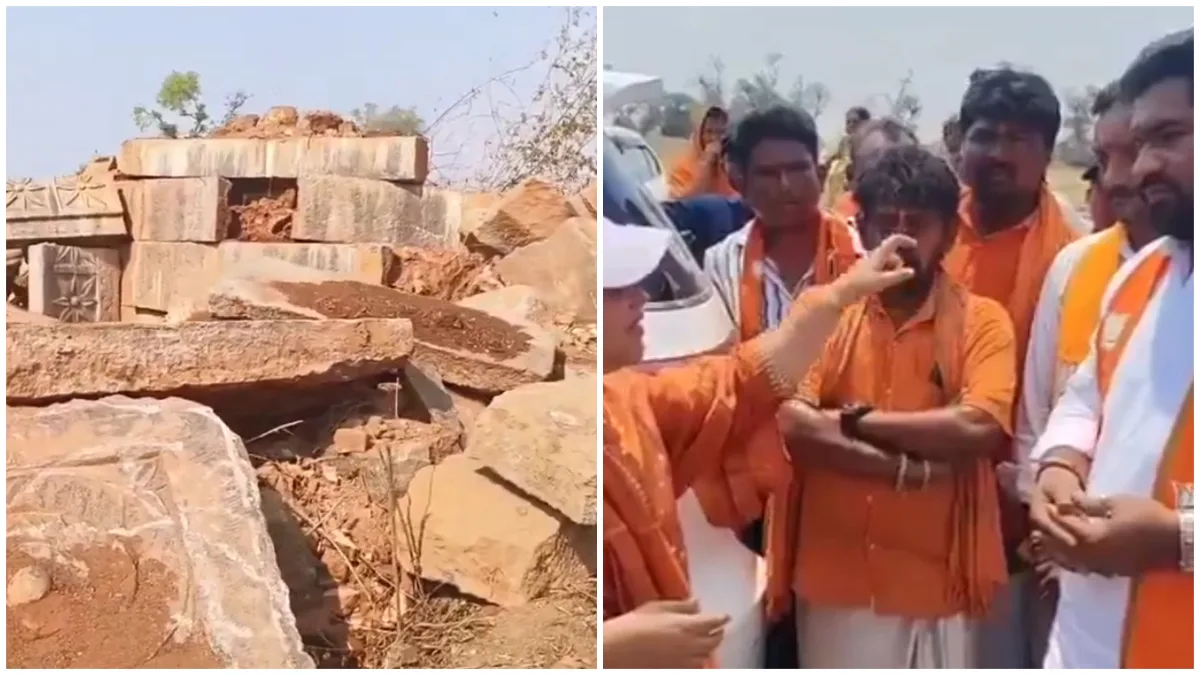
An 800-year-old Shiva temple, believed to date back to the Kakatiya era, has been allegedly demolished in Warangal, setting off a storm of protest from historians, activists and the Union government. The structure, located in Ashok Nagar of Khanapur mandal, was reportedly cleared to make way for a government-run integrated school, prompting demands for accountability and legal action against officials involved.
The controversy has now drawn the attention of the Union Ministry of Culture, with experts calling the incident a serious lapse in heritage protection.
Advertisement
Preliminary accounts suggest the shrine dated back to the 13th century, the reign of Ganapatideva. The site reportedly contained a rare seven-line Telugu inscription from February 1231 AD, referring to the ruler with titles such as “Maharaja” and “Rajadhirajulu”.
Advertisement
The temple had been documented as early as 1965 by the state’s Heritage Department and stood within the historic “Kota Katta” mud fort region, an area known for its ancient defensive structures. Historians argue that the site held significant archaeological value and could have been preserved without disrupting development plans.
Following the demolition, Telangana-based rights lawyer Rama Rao Immaneni moved a complaint before the National Monuments Authority. Acting on the complaint, the Union Ministry of Culture and the Archaeology Department have initiated proceedings.
Legal action is being pursued under provisions of the Telangana Heritage Act, particularly targeting officials accused of allowing construction without mandatory approvals from the Archaeology and Endowments Departments. The complaint also flags the alleged failure of the state to constitute a mandatory Heritage Conservation Committee.
Amid mounting backlash, the district administration has denied any intentional destruction. In a statement issued after a joint inspection on May 6, officials claimed that only “remnants of an old dilapidated structure” were found during the clearing of dense vegetation on the 30-acre site.
Authorities further stated that the structure was not listed as a protected monument in official records.
In an apparent bid to defuse tensions, district officials, including the Warangal Collector Dr Satya Sharada, visited the site along with local MLA Donthi Madhava Reddy. The administration has now promised to reconstruct the temple at the same location.
Officials said the restoration would be carried out in consultation with historians, traditional temple architects (sthapathis), and the Archaeology Department. Steps are also being initiated to ensure a formal protection status for the site going forward.
Heritage experts maintain that the destruction could have been avoided with better planning and adherence to preservation norms. The incident has reignited debate over balancing infrastructure development with the protection of India’s historical legacy, particularly in regions rich in medieval heritage like Telangana.
As the legal process unfolds, the case is likely to test the enforcement of heritage laws and the accountability of local authorities in safeguarding centuries-old monuments.
Advertisement